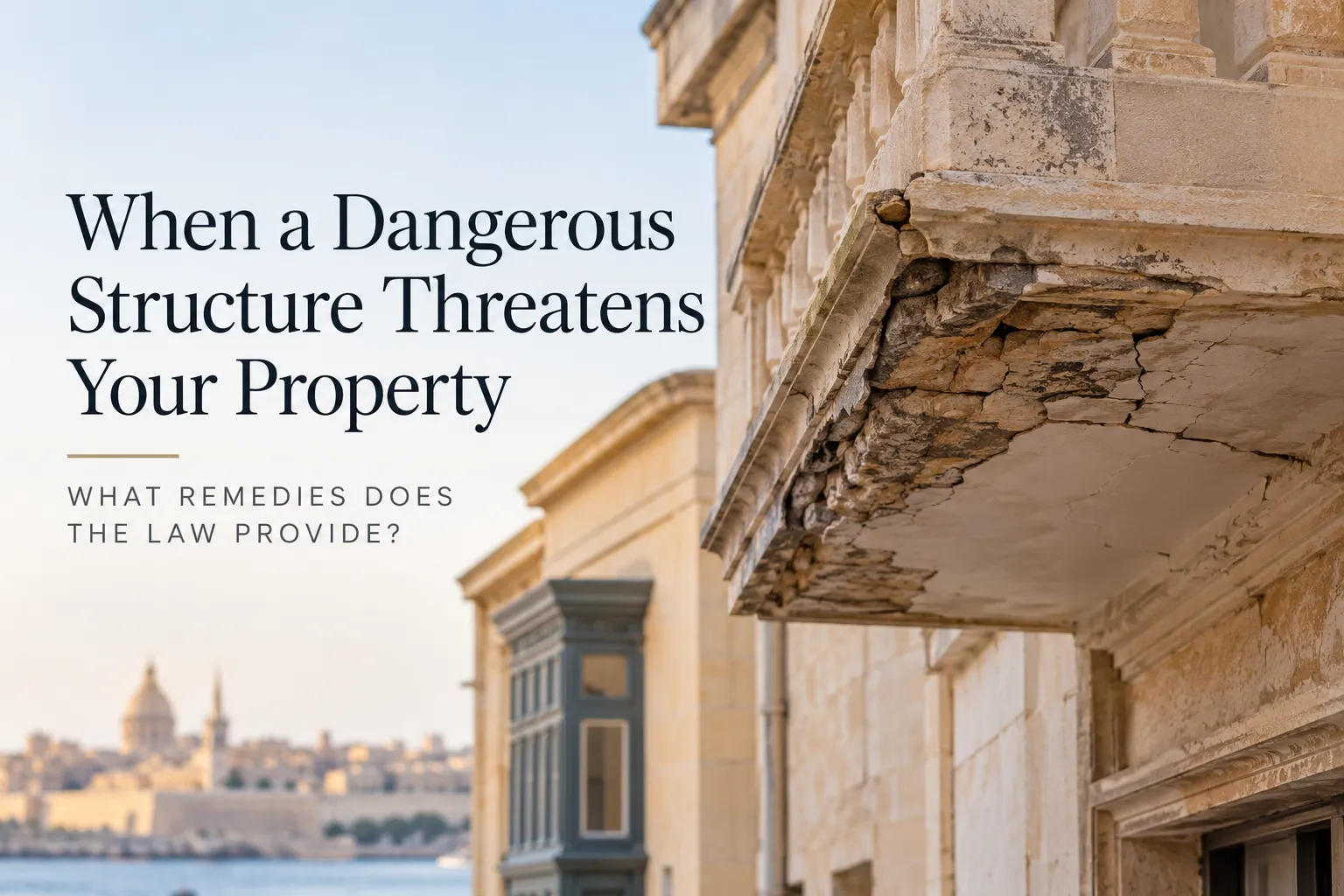
A crack in a neighbouring wall, loose masonry, a deteriorating balcony or an unstable structure may initially appear to be a maintenance issue. However, where a building or other structure presents a real risk of serious damage to neighbouring property, the matter can become a legal one.
Maltese law provides a specific remedy where a person has reasonable grounds to fear that serious and imminent damage may occur to property in their possession because of a neighbouring building, tree or other thing.
The preventive remedy under Article 539
Article 539 of Chapter 16 of the Laws of Malta provides that a person who reasonably fears that serious damage may occur, from one moment to the next, to a tenement or other thing in their possession may bring an action seeking either the steps necessary to remove the danger or security for any damage that may be suffered. This action is commonly known as the actio damno temuto or actio de damno infecto.
The action is preventive in nature. Its purpose is to address a sufficiently serious and imminent risk before the feared damage occurs, rather than to compensate for damage that has already happened.
What must be established?
The claimant must establish two essential elements: first, that the fear of serious damage is reasonable rather than unsubstantiated; and second, that the danger is imminent, not merely a remote or hypothetical possibility.
In Michael Gellel v Frank Borda et (Civil Court, First Hall, 19 February 2004), the Court considered a deteriorating building above a garage occupied by the claimant. Although the claimant had not yet suffered damage, the Court examined the danger posed by the condition of the neighbouring building and the preventative relief sought. The judgment illustrates that the action is intended to address a real risk before damage occurs.
The principles in Gellel were subsequently considered by the Court of Appeal on 25 May 2007. They were also applied in Onor. José Herrera MP v Gollcher Foundation et (Civil Court, First Hall, 25 April 2017), where the Court stressed that the claimant must show a reasonable fear of serious damage and that the damage may occur imminently.
The importance of technical evidence
Architectural and engineering evidence can be central to proving the nature, seriousness and imminence of the risk. A report should identify the relevant defects, explain how they threaten neighbouring property and recommend the works required to remove the danger.
In Herrera v Gollcher Foundation et, the Court considered several technical reports describing the poor condition of the neighbouring building and the remedial works required. It ultimately ordered the necessary works to be identified and carried out under professional supervision. The case demonstrates the value of clear technical evidence, but it is not the only authority addressing Article 539.
A similar practical issue arose in Louis Sammut et v Michael Casha et (Civil Court, First Hall, 29 November 2007), which concerned the risk of damage to a neighbouring property while structural works were being carried out. The case is relevant where the threatened danger arises from construction activity, rather than solely from a building left in disrepair.
The claimant does not necessarily have to be the owner
Article 539 is a possessory action, so the focus is on possession of the property at risk rather than exclusively on ownership. In Gellel v Borda, the claimant occupied the garage under a lease. The decision was later upheld on appeal on 25 May 2007.
The First Hall returned to this issue in Herrera v Gollcher Foundation et, referring to the earlier authorities. The judgments support the proposition that a tenant may, in appropriate circumstances, bring an action under Article 539. The claimant must nevertheless establish the relevant possession and satisfy the statutory requirements on the facts of the case.
What can the Court order?
Article 539 provides two principal forms of relief: an order requiring the necessary steps to remove the danger, or an order requiring the neighbour to provide security for potential damage. The appropriate remedy depends on the circumstances and the evidence.
In Herrera v Gollcher Foundation et, the Court ordered remedial works under professional supervision and addressed who was responsible for carrying them out. The case also illustrates that responsibility for undertaking the works may require careful consideration of the parties involved and the evidence concerning control of, or responsibility for, the dangerous property.
What if damage has already occurred?
Article 539 should be distinguished from an ordinary claim for compensation. Where damage has already occurred, the claim may instead involve the rules on civil liability and tort, depending on the cause of the damage and the parties responsible.
Article 1041 of the Civil Code specifically addresses damage caused by the collapse of a building. It provides for the owner's liability where the collapse is attributable to defects in construction or the need for repairs, subject to the conditions set out in the provision. The appropriate legal route therefore depends on whether the concern is an imminent danger, damage that has already occurred, or both.
Prevention can be as important as compensation
The case law on Article 539 shows that a person need not necessarily wait for a dangerous structure to collapse before seeking judicial protection. The claimant must, however, provide evidence of a reasonable fear of serious damage and of its imminence. Technical reports, photographs, correspondence requesting remedial action and evidence of the condition of the building may all be relevant.
Every case turns on its own facts. In particular, the distinction between an existing danger and damage that has already occurred can significantly affect the remedy available. If a neighbouring property or structure appears to threaten your property, obtaining legal advice at an early stage can help determine the appropriate preventative or compensatory action.
For further information or to arrange an appointment, email francesca.micallef@fmlegal.eu or call 79906659.
This article is intended for general informational purposes and does not constitute legal advice.